Airbnb Rental Arbitrage: The Complete Beginner's Guide (2026)
TL;DR
Sean Rakidzich finds that Airbnb rental arbitrage remains profitable in 2026, particularly in markets with a strong short-term rental (STR) premium and limited regulation.
The article compares the profitability of rental arbitrage to traditional long-term rentals, highlighting that a 50% or higher STR premium is essential for viability.
Sean recommends focusing on mid-size cities with strong tourism demand and limited STR regulations, while avoiding heavily regulated or oversaturated markets. By Sean Rakidzich, 155-property operator. Strategy session at rakidzich.com/book.
Key Facts
| Market Indicator | Green Light | Yellow Light | Red Light |
|---|---|---|---|
| Average STR Occupancy | 65%+ | 55-65% | Below 55% |
| STR Premium | 100%+ | 50-100% | Below 50% |
| STR Regulation | Permit required, no caps | Some restrictions apply | Primary residence only / banned |
| Supply Growth | Below 10% YoY | 10-20% YoY | Above 20% YoY |
Image: TheSanFranRacer, via Wikimedia Commons, CC BY-SA 4.0
Key Takeaways
- What Rental Arbitrage Is (And Is Not)
- Is Rental Arbitrage Still Profitable in 2026?
- How to Choose Your Market: The Right Way
- Finding Landlord-Friendly Properties
- How to Structure Your Rental Arbitrage Deal
- Setting Up and Launching Your First Property
- The ROI Math: Does Rental Arbitrage Make Sense for You?
2026 Rental Arbitrage Ground Truth
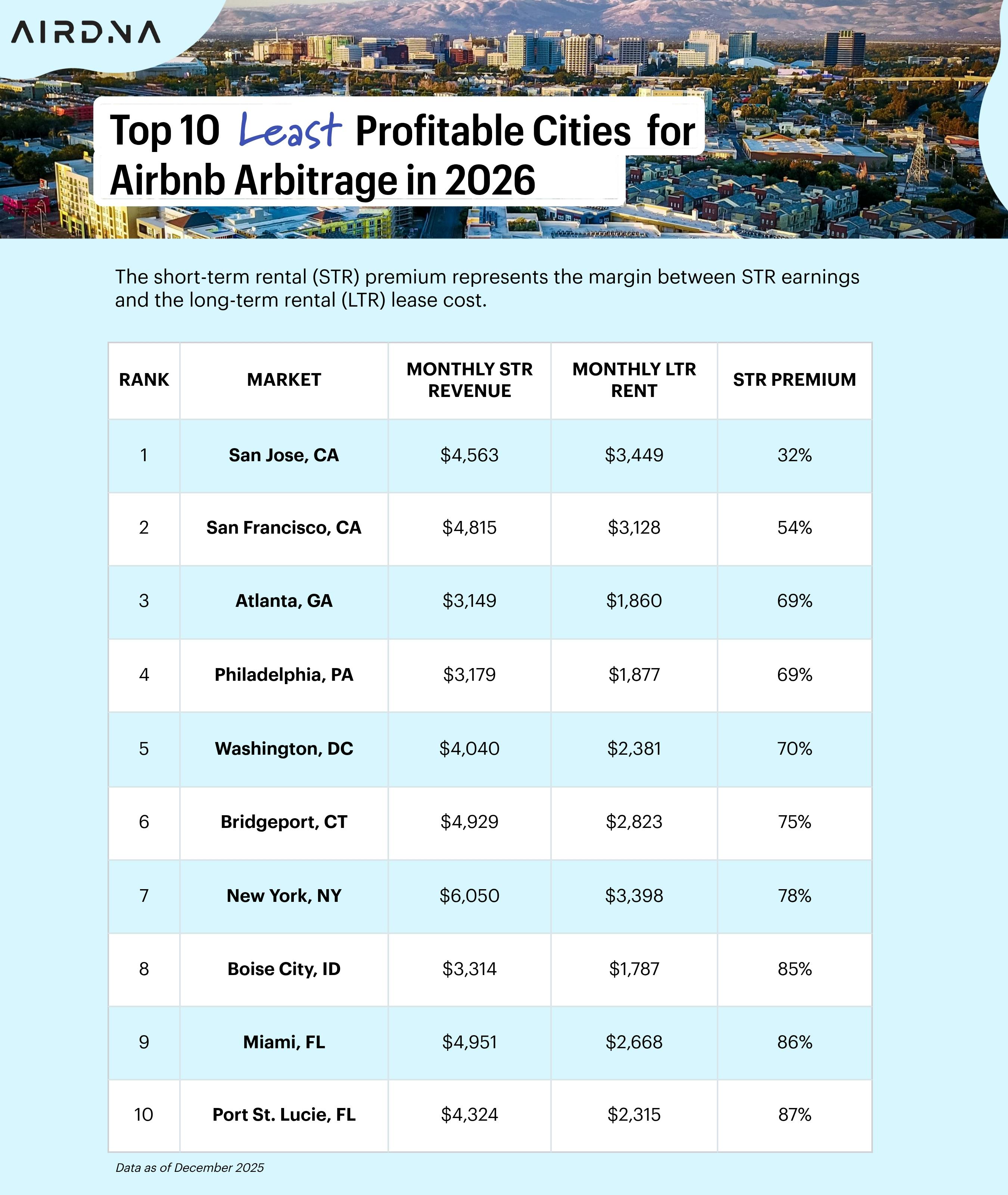
Image via AirDNA
Startup capital, profit margins, and the specific cities that still work in 2026.
- Rental arbitrage startup capital ranges $3,000 to $15,000 per property, with furnishing accounting for 70-80% of total startup costs. — 10XBNB Rental Arbitrage Startup Costs
- Successful rental arbitrage properties return 50% to 200% annually on initial capital. The required baseline: rent-to-revenue ratio of 1:3 or better. — AirDNA Does Airbnb Rental Arbitrage Still Work in 2026
- Gatlinburg, Tennessee leads all US markets at +$698 per month margin. San Antonio, Austin, and Myrtle Beach now lose money on arbitrage after operating costs. — AirDNA 2026 Arbitrage Market Data
- Jamie Lane, AirDNA Chief Economist: “The STR Premium has climbed to its highest level since 2022, and revenue indicators return to more stable growth. Coastal, mountain/lake destinations, and suburban areas of major U.S. cities show some of the most favorable conditions for investors heading into 2026.” — AirDNA 2026 Outlook Report — PR Newswire
Amount of real estate Sean Rakidzich has purchased to build a 100+-property Airbnb portfolio. Rental arbitrage is the model: rent from landlords, sublet on Airbnb, keep the spread.
- Rental arbitrage does not require property ownership. You rent from a landlord and sublet on Airbnb with their permission.
- Setup costs range from $5,000-$15,000 per unit depending on size, location, and furniture quality.
- Market selection is the most critical decision. The STR premium in your chosen city determines whether arbitrage is viable.
- Landlord permission is not optional. Operating without it violates your lease and can get you evicted.
- Legal compliance requires permits in most cities. Check local STR ordinances before your first booking.
- Profitability scales well. Operators who nail their first property use the same system to add 5, 10, or 100+ more.
What Rental Arbitrage Is (And Is Not)
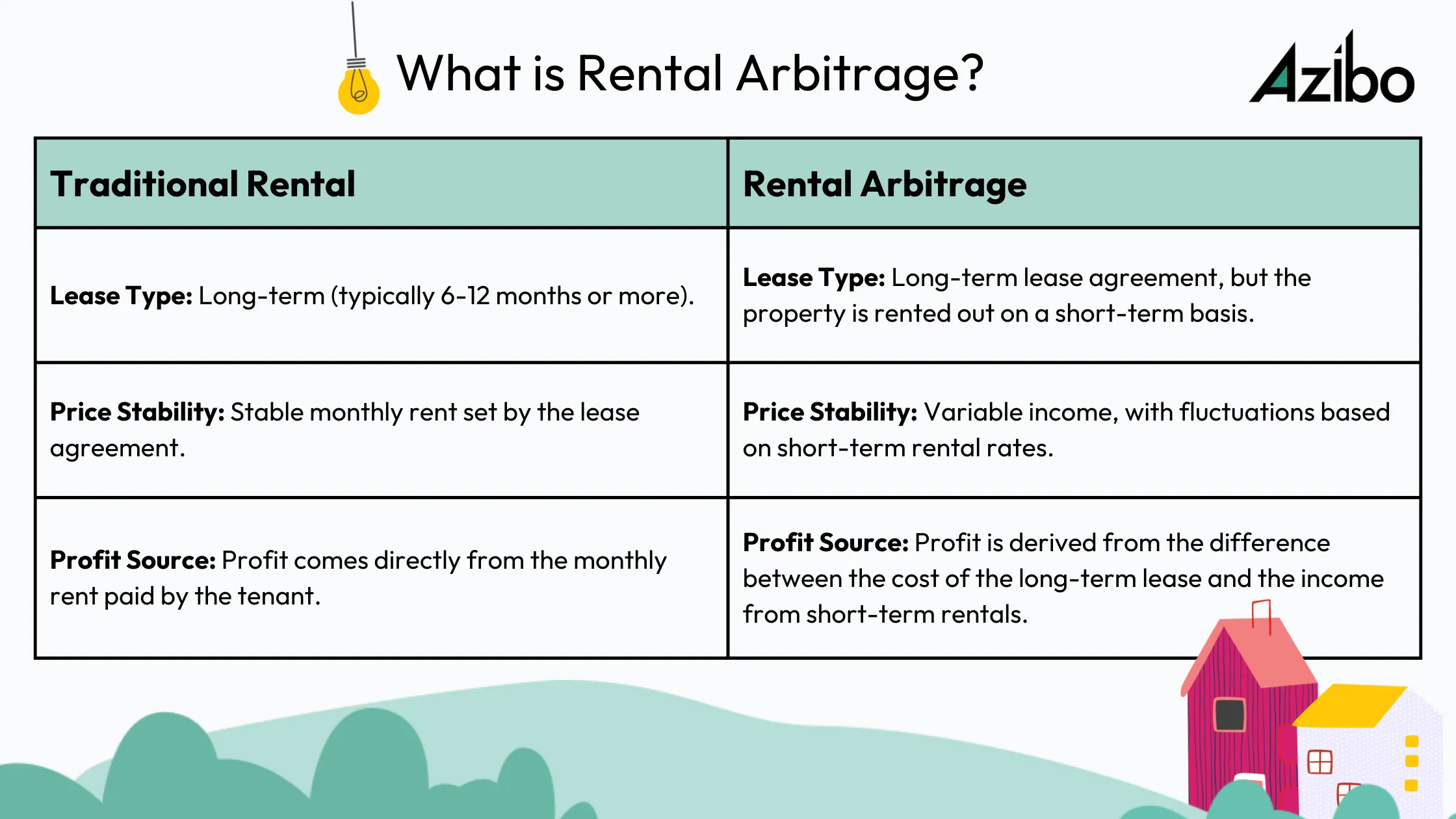
Image via Azibo
Rental arbitrage is when you rent a property from a landlord at a long-term monthly rate and sublet it on Airbnb or VRBO at short-term rates. You keep the spread between what guests pay per night and what you pay the landlord per month.
Example: You rent a furnished one-bedroom in Nashville for $1,400/month. You list it on Airbnb at $120/night. At 60% occupancy, guests pay you 18 nights x $120 = $2,160/month. After platform fees (roughly 3%), you keep about $2,095. Subtract the $1,400 rent and basic operating costs of $200/month, and you net roughly $495/month from one unit.
What rental arbitrage is NOT: It is not subletting without permission (that is lease fraud). It is not running an illegal STR in a city that bans whole-home hosting. And it is not passive income that runs itself. You need systems for guest communication, cleaning, and maintenance.
Every property in Sean's portfolio uses this model. He rents from landlords, operates on Airbnb, and keeps the spread. He has never needed a mortgage, a down payment, or property ownership to scale. The skill is in finding the right markets, convincing landlords, and running operations efficiently enough to profit.
Is Rental Arbitrage Still Profitable in 2026?
The honest answer: yes, in the right markets. Not everywhere.
The U.S. short-term rental market hit a record 1.76 million active listings in mid-2025 according to 2025 STR industry estimates. STR demand grew 6.0% in 2025, well above the 0.3% contraction in traditional hotel demand. That means real demand exists. But supply has also grown, which means the easy markets of 2019-2021 are now more competitive.
STR premium that experts recommend targeting before entering a market for rental arbitrage. A 50% premium means you earn 50% more with Airbnb than with a traditional long-term tenant. That is the minimum viable margin.
The key metric to focus on is the STR premium: how much more Airbnb revenue you earn compared to what a long-term tenant would pay. Markets with a 100%+ STR premium are ideal. Anything above 50% makes arbitrage viable when managed well.
Markets where arbitrage is most viable in 2026 include mid-size cities with strong tourism demand, limited STR regulation, and a meaningful gap between short-term and long-term rental rates. Markets to avoid: heavily regulated cities (NYC, San Francisco), oversaturated markets with low occupancy, and cities where regulations cap or ban non-primary-residence STRs.
How to Choose Your Market: The Right Way
Market selection is the most important decision in rental arbitrage. Choosing wrong is the most expensive mistake you can make. Most operators get this step wrong because they rely on tools that were not built for the question they are trying to answer.
Tools like AirDNA and Mashvisor are widely recommended across the STR industry. After 10+ years operating 100+ properties, Sean's view is direct: the data these tools provide is old, estimated, and incomplete.
Old: Listings that closed years ago stay in the database forever, still counted as active top performers. The market has moved. The tool has not.
Estimated: These platforms infer bookings by watching for calendar changes, not by reading actual transaction records. Your data is a guess built on a guess.
Incomplete: Software can count bedrooms, pools, and nightly rates. It cannot score photo quality, interior design, listing copywriting, or host responsiveness. Those are the things guests actually book on.
Software can give you a rough directional signal. But signing a lease based on scraped estimates from stale data is how operators end up losing money on a property a tool promised would perform. The better tool is free.
Step 1: Check Regulations First
Before any other analysis, check local STR rules. Some cities ban whole-home STRs, require primary residence, or cap the number of licenses. Research this first. If the regulations make arbitrage illegal or unviable, move to the next market. Our full guide to is rental arbitrage legal covers the major cities in detail.
Step 2: Research Directly on Airbnb
The best market research tool is the Airbnb platform itself. It is free, and it shows what Airbnb's algorithm is currently favoring — not what performed well three years ago. Go to Airbnb and search your target city. Set dates to "I'm flexible" and filter by guest count. Try 3 guests and 12 guests separately to see what property sizes the market favors. The listings that appear first are the ones Airbnb believes are most likely to convert right now.
Scroll through the first two pages. Look for patterns: what property type, what size, what amenities, what photo style, what price range. From those patterns, build a thesis — a specific theory about why those listings make money. A strong thesis sounds like: "In this neighborhood, two-bedroom apartments with clean modern design targeting remote workers and weekend visitors make money because both markets overlap here year-round." Specific enough to test. Specific enough to copy. Then try to prove or disprove it before you sign any lease.
Step 3: Read Occupancy Rates Correctly
If you do use occupancy data as a market signal, interpret it carefully. A market averaging 80% occupancy is easier to succeed in than one at 55%, even if the average daily rate is the same. Here is why: at 80%, demand absorbs nearly all available supply. Even average hosts get booked consistently. At 55%, supply outpaces demand. Guests have plenty of options, and only the best listings fill consistently.
For rental arbitrage specifically, this matters a lot. You have a fixed rent to pay every month whether or not a guest books. Steady high occupancy is more valuable than theoretical upside in an oversaturated market where only top performers survive.
Step 4: Calculate the STR Premium
Compare the average Airbnb nightly rate to the long-term rental rate for similar properties in the same area. Calculate: (monthly STR revenue at 60% occupancy) divided by (monthly long-term rental rate). You want this ratio to be at least 1.5x. That leaves room for operating costs and profit.
Step 5: Assess Regulation Stability
A market with strong numbers today but pending STR legislation is a trap. Check city council records, local news, and STR association websites for upcoming restrictions before committing to a lease.
| Market Indicator | Green Light | Yellow Light | Red Light |
|---|---|---|---|
| Average STR Occupancy | 65%+ | 55-65% | Below 55% |
| STR Premium | 100%+ | 50-100% | Below 50% |
| STR Regulation | Permit required, no caps | Some restrictions apply | Primary residence only / banned |
| Supply Growth | Below 10% YoY | 10-20% YoY | Above 20% YoY |
Finding Landlord-Friendly Properties
Most landlords default to "no" on short-term rentals. That is fine. You don't need most landlords. You need the ones who will say yes. Here is how to find them efficiently.
Look for Furnished or Flex-Lease Listings
Properties listed as "furnished," "short-term welcome," or "flexible lease" signal landlords already comfortable with non-standard arrangements. These are your highest-probability targets.
Target Multi-Unit Operators
Individual homeowners with one rental property often have emotional attachment to it. Landlords who manage 10+ units think of rental income as a business. They are more likely to evaluate your proposal on financial merit rather than emotional reaction.
Look in Emerging STR-Friendly Markets
In markets where short-term rentals are common and well-regulated, landlords are more familiar with the model. They have often seen it work with previous tenants. This familiarity reduces the pitch resistance significantly.
How to Find Your First Landlord-Friendly Property
- Search Craigslist, Zillow, and Facebook Marketplace for 'furnished apartment for rent' in your target market
- Filter for landlords managing 5+ units (check the address on Google Street View for multi-family buildings)
- Call or message with a professional introduction as an STR operator
- Be upfront about your business model from the first contact
- Offer a higher-than-market rent to compensate for any perceived risk
How to Structure Your Rental Arbitrage Deal
Getting the landlord to say yes is the skill that separates operators who scale from those who stay stuck at one property. The pitch that works positions you as the best possible tenant, not as a guest-house operator who just happens to be subletting.
The core value proposition for the landlord is:
- Higher monthly rent than a standard long-term tenant
- Property maintained to hotel standards (STR operators clean and maintain frequently)
- Professional management that handles all guest interaction
- No landlord involvement in day-to-day operations
- Lease terms that protect them including liability coverage and damage deposits
The best landlord pitch covers all five points clearly and directly. The best landlords are convinced by numbers and protection, not by enthusiasm. For deep training on this, Closers Crash Course ($800) covers the exact scripts and objection frameworks Sean used to close 100+ deals across 8 markets. Read more in our guide on how to convince a landlord to let you run an Airbnb.
Always get landlord permission in writing. Operating a short-term rental without explicit permission violates your lease and can result in immediate eviction. Either negotiate a subletting clause into your lease before signing, or get a separate written addendum signed by both parties after the fact.
Setting Up and Launching Your First Property
Once you have the deal, you need to set up the property and launch correctly. Your first 30 days of reviews shape your listing's long-term trajectory on Airbnb's algorithm.
Furnishing on Budget
You do not need to spend a fortune on furniture. Focus on: a quality mattress and bedding, clear functional living space, a functional kitchen setup, and fast reliable WiFi. Your target is a clean, hotel-quality experience, not a design showcase. Budget: $2,500-$5,000 for a one-bedroom furnished from scratch.
Smart Home Technology
Install a smart lock (keypad or app-controlled), a noise monitor (like Minut or NoiseAware), and a carbon monoxide/smoke detector. These reduce your time spent on-site and give you remote visibility into what's happening.
Photography
This is not a place to cut costs. Professional listing photos are the single highest-ROI investment you can make in your listing. A good photographer costs $150-$300 and can increase your booking conversion rate substantially. Airbnb even offers professional photography in many markets.
Listing Optimization
Create a complete, compelling listing. Fill every field. Write a description that answers the guest's main question: "Will this place make my trip better?" Price your first 10 bookings competitively to build reviews quickly. Early reviews have an outsized impact on your ranking.
Permits and Insurance
Before your first guest, obtain any required local STR permits and carry liability insurance specifically designed for short-term rentals. Airbnb's AirCover provides some protection but is not a substitute for dedicated STR insurance.
The ROI Math: Does Rental Arbitrage Make Sense for You?
Here is a simple profitability model for a one-bedroom apartment in a mid-tier STR market:
| Item | Monthly Cost/Revenue |
|---|---|
| Long-term rent to landlord | $1,400 |
| Utilities and WiFi | $150 |
| Cleaning costs (avg. 15 cleans/month) | $375 |
| Platform fees and supplies | $150 |
| Total Monthly Costs | $2,075 |
| Airbnb Revenue (18 nights x $120 at 60% occ.) | $2,160 |
| Less 3% Airbnb host fee | -$65 |
| Net Monthly Profit | ~$20 breakeven |
Wait. That math barely breaks even. So why does it work for operators like me at scale?
Two reasons: pricing strategy and market selection. A properly priced listing in a well-chosen market does not run at $120/night average. It captures peak demand pricing ($180-$220/night on weekends), earns through seasonal surges, and averages $150-$160/night with dynamic pricing. That same unit at $155 average generates $2,790/month, a profit of $715/month.
That is the difference between market research and guesswork. And pricing knowledge and winging it. Both the BIG DATA course and Target Price course exist because these two decisions, market and price, determine whether arbitrage makes money or barely breaks even. Browse all airbnb courses at rakidzich.com.
“The math of rental arbitrage is simple. The skill is in the execution: choosing the right market, closing the landlord deal, and pricing correctly from day one. Those three things are worth learning before you sign your first lease, not after.”
300,000+ Subscribers on Airbnb Automated
Sean posts free STR strategies every week. Subscribe for the latest operator insights, pricing tactics, and case studies.
Frequently Asked Questions
What is Airbnb rental arbitrage?
Airbnb rental arbitrage means you rent a property from a landlord at a long-term monthly rate and sublet it on Airbnb at short-term rates. The difference between what guests pay and what you pay the landlord is your profit. You do not own the property. Sean Rakidzich built a 100+-property portfolio using this model.
Is Airbnb rental arbitrage profitable in 2026?
Yes, in markets with high STR demand and a significant premium over long-term rental rates. Airbnb's published host data shows U.S. average STR occupancy around 50-55% nationally. In well-chosen markets with proper pricing, profitable operations typically run 60-75% occupancy with meaningful monthly profit per unit.
How much money do I need to start rental arbitrage?
Most operators need $5,000-$10,000 for a one-bedroom setup, covering first and last month's rent, security deposit, furniture, photography, and platform fees. A two-bedroom typically costs $8,000-$15,000 to launch properly. Some operators start with less by sourcing used furniture.
Do I need permission from my landlord for Airbnb?
Yes, always. Subletting without landlord permission violates your lease and can result in eviction. Rental arbitrage requires either an explicit subletting clause negotiated into your lease before signing, or a separate written agreement with the landlord giving you permission to operate short-term rentals.
What is the STR premium and why does it matter?
The STR premium is how much more short-term rental revenue exceeds what you would earn with a long-term tenant. Experts recommend targeting markets with at least a 50% STR premium for rental arbitrage to be viable. A 100%+ premium means you earn twice as much with Airbnb as with a traditional tenant.
Should I use AirDNA or Mashvisor for rental arbitrage market research?
Sean's position after 10+ years and 100+ properties: use Airbnb itself instead. Third-party tools pull data that is often years old, estimate bookings by watching calendar changes rather than reading real transaction records, and miss everything that actually drives guest decisions — photo quality, design, listing copy, host responsiveness. Research directly on Airbnb with flexible dates and a guest count filter. The listings Airbnb ranks first are what the algorithm is currently rewarding. That intelligence is free and current.
What does a good occupancy rate look like for rental arbitrage?
Target markets averaging 65%+ occupancy — but read the number carefully. A market at 80% average occupancy is easier to profit in than one at 55%, even if the average daily rate is identical. At 80%, demand absorbs almost all available supply. Even average hosts fill consistently. At 55%, supply outpaces demand and guests have options, so only the best listings win every booking. For rental arbitrage with a fixed monthly rent due regardless of vacancy, steady high occupancy is more valuable than potential upside in a market where you have to out-compete everyone just to break even.
Is rental arbitrage risky?
The main risks are: (1) Regulatory changes — cities can ban or restrict STRs. (2) Lease termination — landlords can choose not to renew. (3) Seasonality — some markets have sharp off-seasons. (4) Market saturation — too many listings competing for guests. Mitigation: diversify across markets, negotiate longer lease terms, maintain a cash reserve of 3 months' rent per property, and always have landlord permission in writing.
Learn the Full Rental Arbitrage System
Learn from Sean Rakidzich: 100+ properties, 5,000+ students, $1.4B in results.
Browse Airbnb CoursesAbout the Author
This analysis is by Sean Rakidzich, an 11-year short-term rental operator who manages 155 Airbnb properties generating $1M+/month in revenue. Sean has trained 5,000+ students across 76 countries with $1.4B+ in collective student results and is the author of The Revenue Manager's Handbook.
For Sean's framework on Airbnb rental arbitrage remains profitable in 2026, particularly in markets with a strong short-term rental (STR) premium and limited regulation, see his full content library at rakidzich.com or book a 30-minute strategy session at rakidzich.com/book.